Incompressible Fluids
The CoolProp project not only supports Pure Fluids wrapped by the EngCoolProp EC_Fluid object EC_Fluid Functions, but also Incompressible Fluids wrapped by the EngCoolProp EC_Incomp_Fluid object EC_Incomp_Fluid Functions.
To see a list of all incompressible fluids execute the following script:
from CoolProp import __incompressibles_pure__
print( __incompressibles_pure__ )
In March 2025, results in the list: [‘Acetone’, ‘Air’, ‘AS10’, ‘AS20’, ‘AS30’, ‘AS40’, ‘AS55’, ‘DEB’, ‘DowJ’, ‘DowJ2’, ‘DowQ’, ‘DowQ2’, ‘DSF’, ‘Ethanol’, ‘ExampleDigitalPure’, ‘ExamplePure’, ‘FoodAsh’, ‘FoodCarbohydrate’, ‘FoodFat’, ‘FoodFiber’, ‘FoodIce’, ‘FoodProtein’, ‘FoodWater’, ‘HC10’, ‘HC20’, ‘HC30’, ‘HC40’, ‘HC50’, ‘HCB’, ‘HCM’, ‘Hexane’, ‘HFE’, ‘HFE2’, ‘HY20’, ‘HY30’, ‘HY40’, ‘HY45’, ‘HY50’, ‘LiqNa’, ‘NaK’, ‘NBS’, ‘PBB’, ‘PCL’, ‘PCR’, ‘PGLT’, ‘PHE’, ‘PHR’, ‘PLR’, ‘PMR’, ‘PMS1’, ‘PMS2’, ‘PNF’, ‘PNF2’, ‘S800’, ‘SAB’, ‘T66’, ‘T72’, ‘TCO’, ‘TD12’, ‘TVP1’, ‘TVP1869’, ‘TX22’, ‘TY10’, ‘TY15’, ‘TY20’, ‘TY24’, ‘Water’, ‘XLT’, ‘XLT2’, ‘ZS10’, ‘ZS25’, ‘ZS40’, ‘ZS45’, ‘ZS55’]
For incompressible fluids, EngCoolProp uses units of primarily inch, lbm, lbf, sec, BTU (some use of ft and hour).:
The following are the default units for each property.

T    = Temperature = degR
Tsat = Saturation Temperature (T if P==Psat) = degR
Tnbp = Normal Boiling Point = degR
P    = Pressure = psia
Psat = Saturation Pressure (Vapor Pressure at T) = psia
D    = Density = lbm/cu ft
rho  = Density = lbm/cu inch
E    = Internal Energy = BTU/lbm
H    = Enthalpy = BTU/lbm
S    = Entropy = BTU/lbm degR
Cp   = Heat Capacity (const. P) = BTU/lbm degR
V    = Viscosity = 1.0E5 * lb/ft-sec
C    = Thermal Conductivity = BTU/ft-hr-R
Default State Point
Create a listing of properties at the default state point. (i.e. T=(Tmax+Tmin)/2, P=Pmax/10):
from engcoolprop.ec_incomp_fluid import EC_Incomp_Fluid

# Create incompressible object. (without specifying state point)
ec_inc = EC_Incomp_Fluid(symbol="Water", auto_fix_value_errors=True, show_warnings=2 )

# Print state point
ec_inc.printProps() # Print state point at given T,P
Output:
+----------------------------------------------------------------+
|     NOTICE: any input violations on limits of T, D, H or S     |
|      will be automatically corrected (set to min or max).      |
|  To change this behavior set "auto_fix_value_errors" to False  |
|     To suppress this banner set "show_warnings" to 0 or 1      |
+----------------------------------------------------------------+
State Point for fluid INCOMP::Water (Water)
T =      671  degR,                              Range(  491.67 -   851.67) degR
P =     1000  psia                               Range(       0 -    10000) psia
D =   60.043  lbm/cuft                           Range( 54.2479 -  62.6328) lbm/cuft
E =  142.121  BTU/lbm                            Range(-36.7331 -  328.172) BTU/lbm
H =  145.203  BTU/lbm                            Range(-35.9312 -  342.116) BTU/lbm
S = 0.238477  BTU/lbm degR                       Range(-0.072072 - 0.483928) BTU/lbm degR
Cp=  1.00285  BTU/lbm degR                       Range(0.999244 -  1.06583) BTU/lbm degR
V =  19.0492  viscosity [1.0E5 * lbm/ft-sec]     Range( 9.17101 -  118.181)
C = 0.393587  thermal conductivity [BTU/ft-hr-R] Range(0.324617 -   0.3845)
    Tnbp =  671.707  degR,
    rho  =0.0347471  lbm/cuin                    Range(0.031393 - 0.036246) lbm/cuin
    Psat =  14.4914  psia                        Range(0 - 226.073) psia
Can also print short forms of properties as:
ec_inc.printTPD()

ec_inc.printTransport()
Output:
INCOMP::Water T= 671.0 P=1000.0 D=60.0430 E=142.12 H=145.20 S=0.238
INCOMP::Water Cp=1.00285 Visc=19.0492 ThCond=0.393587
State Point
Create a listing of properties at a given T and P. Note that Pmax is specified.
Pmax is the highest pressure considered in any iterative calcs. The default value for Pmax is 10,000 psia(see Range of P above). It is usually best to keep Pmax above the max pressure being analyzed.:
# Create incompressible object at T=500 degR, P=500 psia and max pressure = 5000 psia
ec_inc = EC_Incomp_Fluid(symbol="Water", T=500, P=500, Pmax=5000) # T=degR, P=psia

# OR... After ec_inc has been crated
ec_inc.setTP( 500, 500)

# Print state point
ec_inc.printProps()
Output:
State Point for fluid INCOMP::Water (Water)
T =       500  degR,                              Range(  491.67 -   851.67) degR
P =       500  psia                               Range(       0 -     5000) psia
D =   62.6007  lbm/cuft                           Range( 54.2479 -  62.6328) lbm/cuft
E =  -27.7038  BTU/lbm                            Range( -36.353 -  328.172) BTU/lbm
H =  -26.2257  BTU/lbm                            Range(-35.9729 -  335.377) BTU/lbm
S =-0.0538473  BTU/lbm degR                       Range(-0.071299 - 0.483928) BTU/lbm degR
Cp=   0.99868  BTU/lbm degR                       Range(0.999244 -  1.06583) BTU/lbm degR
V =   102.357  viscosity [1.0E5 * lbm/ft-sec]     Range( 9.17101 -  118.181)
C =  0.330189  thermal conductivity [BTU/ft-hr-R] Range(0.324617 -   0.3845)
    Tnbp =   671.707  degR,
    rho  = 0.0362273  lbm/cuin                    Range(0.031393 - 0.036246) lbm/cuin
    Psat =         0  psia                        Range(0 - 226.073) psia
printSIUnits
Although EngCoolProp was created to promote English units when using CoolProp , it is often helpful to see properties in SI units.
For that reason, all the EngCoolProp models have a method called printSIUnits that will output the State Point with SI units. The script below shows the result of calling printSIUnits:
from engcoolprop.ec_incomp_fluid import EC_Incomp_Fluid

# Create incompressible object. (without specifying state point)
ec_inc = EC_Incomp_Fluid(symbol="Water", T=500, P=500, Pmax=5000,
                        auto_fix_value_errors=True, show_warnings=0 )

# Print state point with SI units
ec_inc.printSIProps() # Print state point at given T,P
Output:
State Point for fluid INCOMP::Water (Water)
T =    277.778  degK,                            Range(     273.15 -      473.15) degK
P =3.44738e+06  Pa                               Range(          0 - 3.44738e+07) Pa
D =    1002.77  kg/m^3                           Range(    868.966 -     1003.28) kg/m^3
E =     -64439  J/kg                             Range(   -84557.2 -      763327) J/kg
H =   -61001.1  J/kg                             Range(     -83673 -      780087) J/kg
S =   -225.448  J/kg/K                           Range(   -298.514 -     2026.11) J/kg/K
Cp=    4181.27  J/kg/K                           Range(    4183.63 -     4462.41) J/kg/K
V = 0.00152325  viscosity Pa s                   Range( 0.00013648 -  0.00175873) Pa s
C =   0.571088  thermal conductivity W/m/K       Range(   0.561449 -    0.665022) W/m/K
    Tnbp =    373.171  degK,
    rho  =    1.00277  g/cm^3                    Range(   0.868967 -     1.00328) g/cm^3
    Psat =          0  Pa                        Range(          0 - 1.55872e+06) Pa
Acetone State Point
The above examples were for Water that has saturation properties included in CoolProp. Acetone does not have saturation properties. An example with Acetone looks as follows:
from engcoolprop.ec_incomp_fluid import EC_Incomp_Fluid

# Create incompressible object. (without specifying state point)
ec_inc = EC_Incomp_Fluid(symbol="Acetone" )

# Print state point
ec_inc.printProps()
As before, the default state point is T=(Tmax+Tmin)/2, P=Pmax/10
Output:
State Point for fluid INCOMP::Acetone (Acetone)
T =      553  degR,                              Range(  356.67 -  749.665) degR
P =     1000  psia                               Range(       0 -    10000) psia
D =   48.427  lbm/cuft                           Range( 39.3847 -  55.7377) lbm/cuft
E =  11.2384  BTU/lbm                            Range(-91.8912 -  123.564) BTU/lbm
H =  15.0596  BTU/lbm                            Range(-83.7831 -  123.564) BTU/lbm
S =0.0209767  BTU/lbm degR                       Range(-0.214127 - 0.194387) BTU/lbm degR
Cp= 0.516159  BTU/lbm degR                       Range(0.476931 - 0.623845) BTU/lbm degR
V =  23.0543  viscosity [1.0E5 * lbm/ft-sec]     Range( 12.4036 -  113.822)
C =        0  thermal conductivity [BTU/ft-hr-R] Range(       0 -        0)
    rho  =0.0280249  lbm/cuin                    Range(0.022792 - 0.032256) lbm/cuin
Making Plots
An easy way to make plots is to use the matplotlib package.
To install matplotlib give the commands:
pip install matplotlib
   ... OR to upgrade...
pip install --upgrade matplotlib
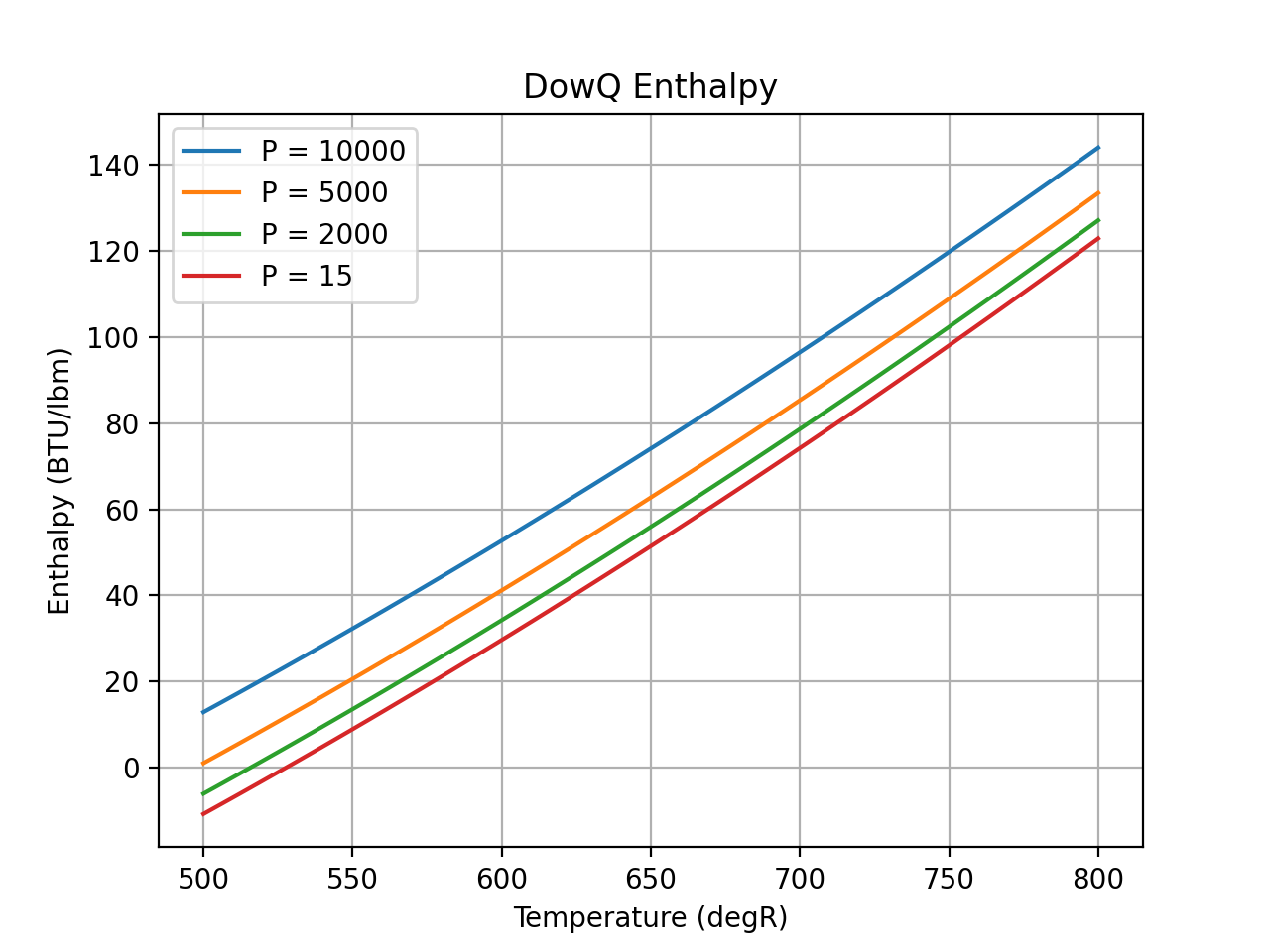
The example below will plot the enthalpy (H) of DowQ as a function of temperature and pressure.:
import matplotlib.pyplot as plt
import numpy as np
from engcoolprop.ec_incomp_fluid import EC_Incomp_Fluid

# Create incompressible solution object. (without specifying state point)
ec_inc = EC_Incomp_Fluid(symbol="DowQ", auto_fix_value_errors=True, show_warnings=0 ) # T=degR, P=psia

tArr = np.linspace(500, 800, 50)

# Use a few different pressures
for P in [10000, 5000, 2000, 15]:

    densL = []
    for T in tArr:
        ec_inc.setTP( T, P)
        densL.append( ec_inc.H )

    plt.plot( tArr, densL, label="P = %g"%P)

plt.grid( True )
plt.title( 'DowQ Enthalpy')
plt.xlabel( 'Temperature (degR)')
plt.ylabel( 'Enthalpy (BTU/lbm)')
plt.legend( loc='best' )

plt.savefig( 'DowQ_enthalpy.png', dpi=200)
plt.show()